Sharper Bevels, Fewer Repairs: Choosing Tool Bits for On-Site Pipe Beveling, Facing , Compound Beveling applications
On a pipeline spread or a refinery shutdown, the weld is only as good as the bevel — and the bevel is only as good as the tool bit in the machine. Portable beveling machines bring the lathe to the pipe. They clamp onto or inside the pipe and cut the weld preparation where it stands. But a portable head is less rigid than a lathe, pipes are rarely perfectly round, and stainless or Cr-Mo grades punish a weak edge. A bit that drifts 2° or loses its land after a few joints means poor fit-up and weld repairs.
What a good Tool Bit gets right
A ROHIT parting blade: the ground chip curl at the tip turns the chip away from the face.
Five features separate a site-ready bevel tool from a hand-ground blank:
- Ground bevel angle — 30°, 37° or 37.5°, cut to drawing so the machine reproduces the WPS angle every joint.
- Chip groove radius — R6, R7 or R12 behind the edge curls the chip and lowers cutting force. Long stringy chips on stainless wrap the head; a proper groove stops that.
- Clearance and side relief — 2° to 8° clearance and 1.5° to 3° side relief keep the flank from rubbing and work-hardening the pipe face.
- Two edges, one blank — double-sided tools flip end-for-end when one edge wears, so the crew keeps cutting without a tool change.
- Right hand and left hand — the hand follows the machine's rotation and slide direction.
Left to right: double-side inside bevel (30° / 37.5°), inside compound bevel (10° × 37.5°), single-side inside bevel - all 25 × 25 × 200 mm.
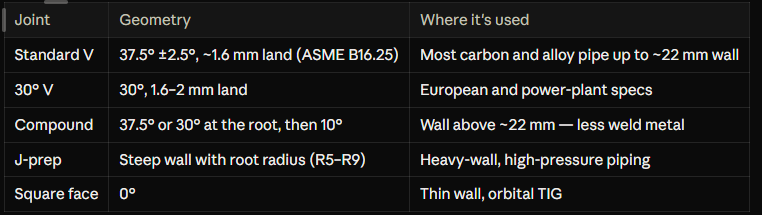
Start with the joint
The weld procedure (WPS) fixes the shape; the tool is ground to cut it in one pass.
Match the grade to the pipe
Cobalt HSS, not carbide, is the usual choice on portable machines: it takes the shock of ovality, weld seams and tack welds without chipping, and it can be reground.
Speeds are starting values; stay within the machine maker's limits.
Five habits for clean bevels on site
- Set the bit on centre height and square to the face before the first cut.
- Clamp rigidly and check ovality — an oval pipe means an interrupted cut.
- Feed steadily; never let the tool dwell, especially on stainless.
- Use cutting oil wherever the machine allows.
- Flip a double-sided tool at the first sign of poor finish, before the edge chips.
Get the right tool for your machine
ROHIT Cutting Tools has ground cutting tools since 1963. Our pipe range covers single- and double-side bevel tools, inside compound bevel tools and parting blades, in 3X T-42 HSS and EC-500, uncoated or TiN / AL-PRO coated. J-prep, facing tools and machine-specific shanks are made to drawing.
Send us your drawing / bevel spec and pipe material — we'll match the tool.
If you have any other questions or need help fine-tuning your milling operations to eliminate chatter, feel free to leave a comment below or .
Contact RIGPL Today for Professional help
WhatsApp +91-85869-23456 | E: sales@rigpl.com